Three men were killed in the strike, bringing the total number killed in military anti-drug activity to 83.
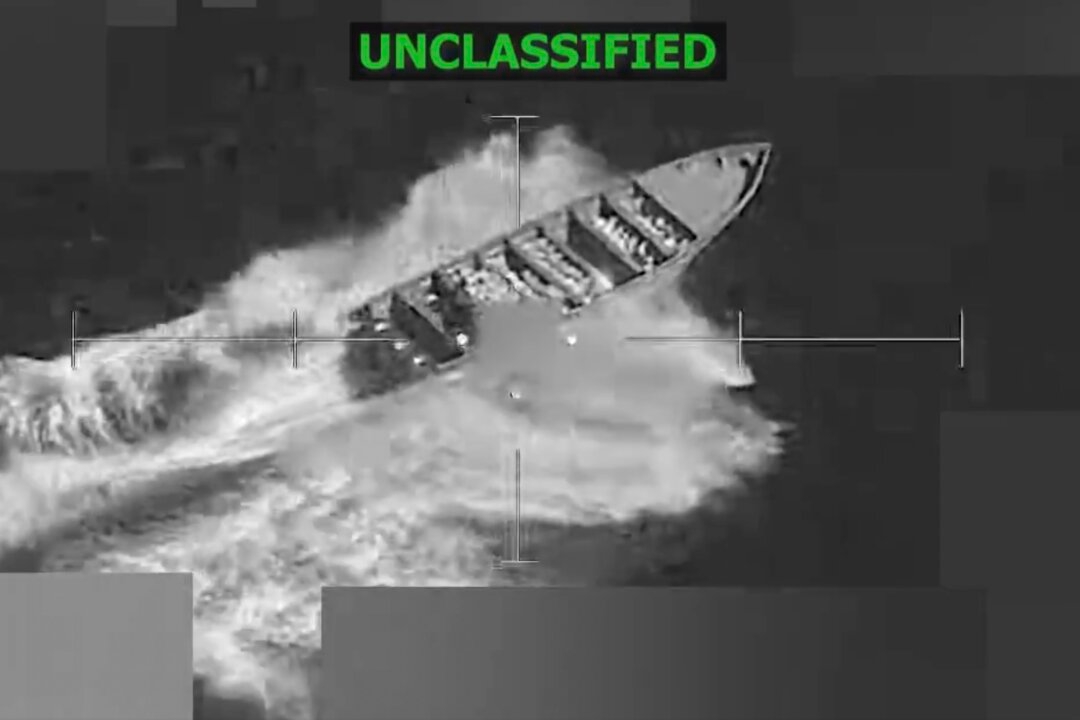
The U.S. military this weekend carried out its 21st military strike on a suspected drug trafficking boat.
“On Nov. 15, at the direction of Secretary of War Pete Hegseth, Joint Task Force Southern Spear conducted a lethal kinetic strike on a vessel operated by a Designated Terrorist Organization. Intelligence confirmed that the vessel was involved in illicit narcotics smuggling, transiting along a known narco-trafficking route, and carrying narcotics,” U.S. Southern Command said via a post on X.
A video attached to the post showed unclassified military footage of a medium-sized motor-powered boat on the eastern Pacific Ocean operating in international waters.
A single airstrike dispatched the boat, killing three “male narco-terrorists aboard the vessel,” the administration said.
The newly announced strikes bring the total number of suspected drug boat airstrikes to 21, with the three reported deaths bringing the total casualty count to 83 people.
The strike followed four similar attacks earlier this month.
Venezuela
U.S. military activity against alleged drug traffickers has been expansive, with the administration beginning the push with strikes in the sea around Venezuela, and since then extending the activity into the eastern Pacific Ocean near Colombia’s coastline.
U.S. officials accuse Venezuelan leader Nicolás Maduro of overseeing an international cocaine-trafficking conspiracy and using violent drug cartels to consolidate his power.
In late October, Hegseth directed an aircraft carrier strike group to enter the area of responsibility of the U.S. Southern Command (Southcom)—which oversees the Caribbean, South America, and the seas surrounding both—to reinforce the effort.
On Nov. 11, the Navy announced that the USS Gerald R. Ford—the United States’ state-of-the-art nuclear-powered aircraft carrier, the most technologically advanced in the U.S. fleet—and its strike group had arrived in the Southcom region.
The carrier, staffed by more than 4,000 sailors, is equipped with F/A-18 Super Hornet fighter jets and long-range Tomahawk cruise missiles.
On Nov. 14, U.S. President Donald Trump said that he has already decided on his next steps concerning the Maduro regime, signaling that Washington is preparing new military measures as its posture in the Caribbean expands.
“I sort of made up my mind,” the president told reporters aboard Air Force One when asked about recent high-level discussions within his administration regarding Venezuela and the amassing U.S. forces near its shores. He added, “I can’t tell you what it would be"
War Powers Debate
The drug boat strikes have prompted debate among lawmakers and international figures, with critics questioning the administration’s authority to carry out the airstrikes under U.S. war powers law.
Trump has said that the strikes are legal, portraying them as a lawful and limited engagement with foreign terrorists that doesn’t require congressional approval or violate the War Powers Act.
Critics have pointed to prohibitions under international law’s on carrying out military activity on international waters except when necessary to preserve life, questioning the administration’s position that drug trafficking constitutes an “armed attack” under international law justifying a lethal response.
Some in the president’s own party, including Sen. Rand Paul (R-Ky.) and Rep. Thomas Massie (R-Ky.), have portrayed the strikes as an overreach of executive authority that should require congressional approval.
Paul has described the strikes as “summary executions” and “extrajudicial killings” that violate American legal norms.
Drug enforcement is traditionally considered a law enforcement activity requiring the protection of civil rights, rather than military action.
The Department of Justice (DOJ) has stated that military personnel involved in the strikes are not liable to prosecution for their conduct.
Bill Pan contributed to this report.