U.N. findings say gangs control most of Haiti’s capital Port-au-Prince and that violence has displaced more than 1.4 million people.
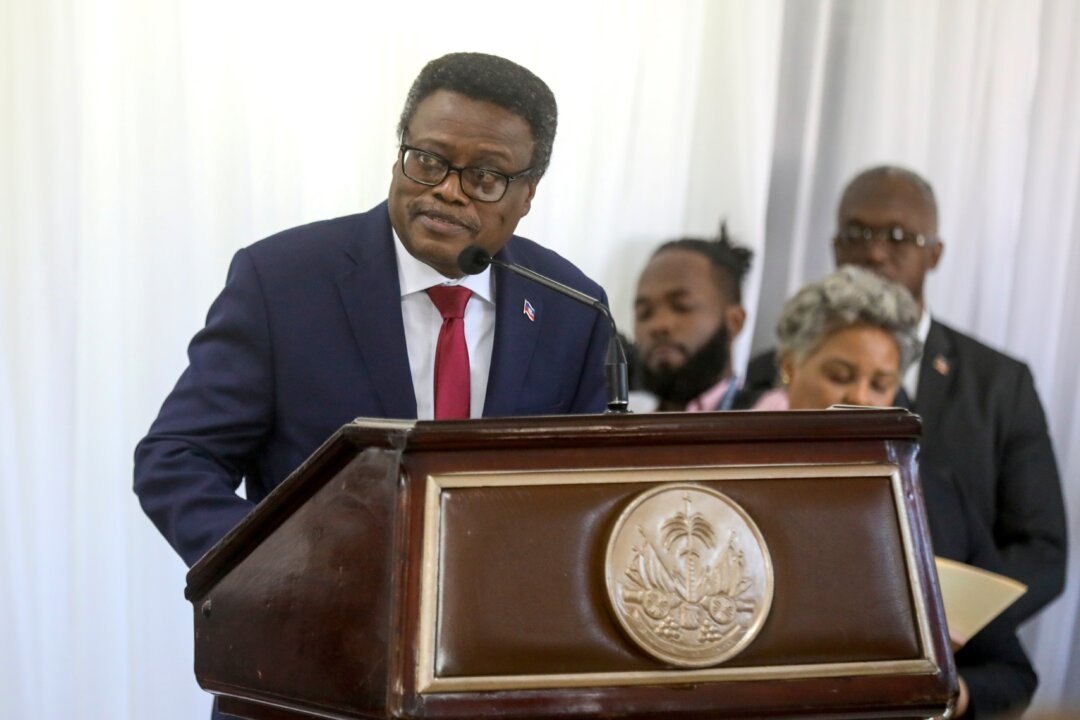
The U.S. State Department said on Nov. 24 it was taking steps to impose visa restrictions on a Haitian government official accused of supporting gangs and obstructing efforts by Haiti’s government to combat what Washington calls terrorist organizations.
The action was taken under U.S. law that bars entry to individuals whose activities could have serious adverse foreign policy consequences for the United States.
The sanction falls under a U.S. policy first announced in October 2022, which targets individuals and their family members who provide “financial or material support” to gangs and criminal organizations operating in Haiti.
The department said it would also revoke any valid visas held by the unnamed official.
“The United States remains committed to supporting Haiti’s stability and expects measurable progress toward free and fair elections,” the U.S. State Department said. “The Haitian people have had enough with gang violence, destruction, and political infighting. The Trump Administration will promote accountability for those who continue to destabilize Haiti and our region.”
A member of Haiti’s transitional presidential council, Fritz Alphonse Jean, told The Associated Press on Nov. 25 that he was the sanctioned official.
The council was created after former Prime Minister Ariel Henry resigned in 2024 amid a surge in gang violence that left the country without a functioning government.
Jean refuted the State Department’s allegations, claiming that council members have been “receiving threats of visa cancellation and other sanctions from the U.S. Embassy representative and the Canadian ambassador.”
The Epoch Times contacted the Canadian Embassy in Haiti for comment but did not receive a reply before publication.
Haiti is expected to hold elections by Feb. 7, when the nine-member council is scheduled to leave office.
“We stand firm on combating corruption, state capture by few individuals, and operators involved in drugs trafficking, weapons and ammunition’s [sic] proliferation,” Jean added.
Haiti has been grappling with a severe political, humanitarian, and security crisis following the assassination of President Jovenel Moise in 2021.
More than 1.4 million people have been displaced internally, according to the United Nations. In an Oct. 22 briefing, the head of the U.N. office in Haiti, Carlos Ruiz Massieu, described the human rights situation in Haiti as “deeply concerning.”
He cited widespread abuses linked to gang attacks, violence by self-defense groups, and incidents tied to some security operations.
In October 2023, the U.N. Security Council authorized the deployment of a multinational security support mission, led by Kenya, to help Haitian police tackle gang violence.
According to a U.N. report, on Sept. 30, the mission “faced chronic underfunding, insufficient personnel, and limited operational capacity, making it difficult to contain gangs that now control large parts of the capital, Port-au-Prince.”
It was replaced by the multinational Gang Suppression Force (GSF) in September, following a Security Council resolution, co-penned by the United States and Panama. The GSF, a 5,550-member force, has a 12-month mandate to help neutralize gangs, protect infrastructure, and assist humanitarian operations.
The GSF will transition to an international burden-sharing model with the sufficient resources needed to fight the gangs, U.S. Secretary of State Marco Rubio said on Oct. 1.
“The message from the Security Council is clear: the era of impunity for those who seek to destabilize Haiti is over,” he said, calling on all nations to join in the effort to bring stability to the region.
US Embassy Alert
The U.S. Embassy in Port-au-Prince issued a security alert on Nov. 24 highlighting the extent of gang-related violence in the capital.
The embassy said that Sunrise Airlines, a Haitian regional carrier, had suspended flights after a shooting incident involving one of its planes. Gang activity is limiting travel along major highways linking the capital to other parts of the country, and leaving or entering Port-au-Prince has become “increasingly dangerous,” the alert said.
The embassy reiterated a State Department advisory against traveling to Haiti. It warned that Americans unable to depart should be prepared for disruptions to critical infrastructure, including seaports, roads, and airports, and should expect shortages of fuel, water, and food.
The embassy said that remaining U.S. citizens should be prepared to shelter in place amid an unstable security environment. It added that the embassy has reduced staffing and has limited capacity to assist Americans. Earlier this month, U.S. Marines guarding the U.S. Embassy in Port-au-Prince came under fire from suspected gang members and briefly exchanged fire.
More than 5,600 people were killed in Haiti in 2024, the U.N. said in an Oct. 1 report. The report stated that since March, the violence has expanded further into previously untouched areas of the country outside the capital. About 90 percent of Port-au-Prince was under the control of armed groups, the U.N. said.
In an effort to curb gang violence, the United States said in July it would give an additional $60 million in humanitarian aid and security assets to Haiti.
The package brought the total U.S. humanitarian support for the Caribbean country to $165 million in 2025, U.S. Ambassador to the U.N. Linda Thomas-Greenfield said during her visit to Haiti on July 22.