The first time Maria Elena Santos appeared at the Riverside border crossing, nobody wrote down her name correctly. It was a Tuesday in late September, the kind of morning where the heat hadn’t yet brutalized the desert and the guards stood in the shade of the checkpoint booth, drinking lukewarm coffee and smoking cigarettes because even conversation felt like it required energy they didn’t want to spend.
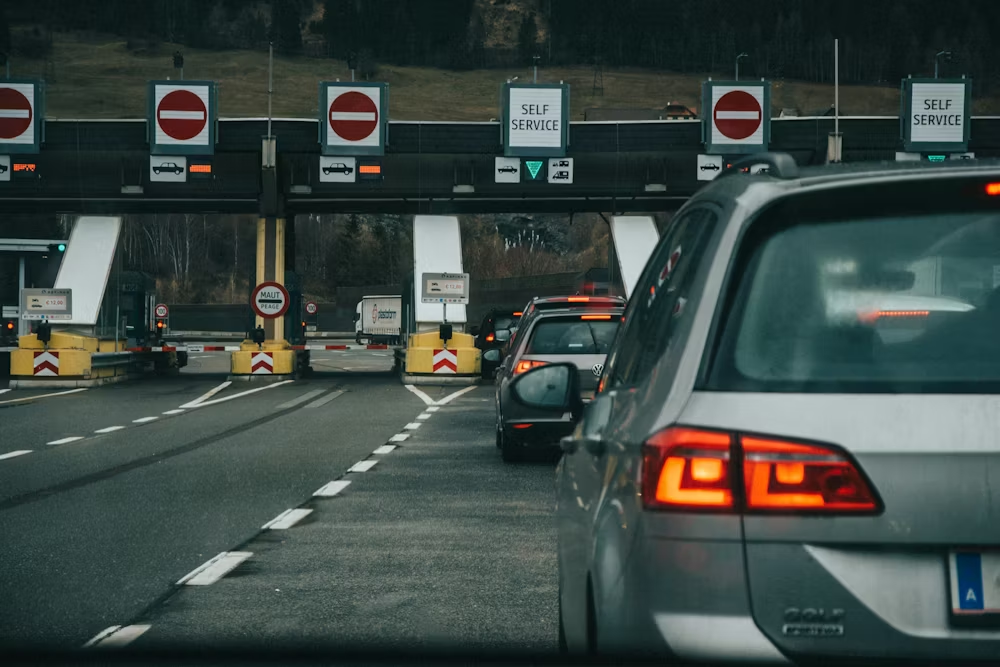
The checkpoint was small—two lanes, a metal booth with windows that didn’t open properly, a barrier arm that needed maintenance, and a tower nobody had climbed in three years because the stairs creaked in ways that suggested structural concerns and the view of the desert wasn’t worth the risk.
Agent Daniel Rivers was twenty-four years old and already tired. Not the tired of youth—not heartbreak or ambition or the restless energy of a young man who wanted to be promoted, transferred, or reassigned to somewhere less monotonous. Just the flat, institutional tired of a person who stood in the same spot for twelve hours a day, checking documents, raising and lowering the barrier, and watching the same cargo trucks carry the same goods across the same international bridge to warehouses that probably didn’t care who had verified their contents.
He noticed the bicycle first.
It was old—not neglected, but weathered, as though it carried stories embedded in its frame. A heavy-duty mountain bike with rust blooming along the chain guard, a cracked leather seat worn to the contours of its long-time rider, and handlebars that had been bent and straightened so many times they curved slightly like the horns of a stubborn animal. The front basket was large, made of woven wire reinforced with twine, and it contained a burlap sack tied with a careful knot.
The woman pushing the bicycle was small. Not frail—there’s a difference, and Daniel would learn it over the years—but efficient, as though life had boiled her down to only the essential parts. She wore a wool coat that had been mended so many times the patches had patches, and her face was the color of aged leather, lined with wrinkles that came from squinting into sun and wind rather than frowning at people.
She walked the bicycle up to the checkpoint barrier, stopped, and waited with the patience of a woman who had spent her entire life waiting for people in uniform to decide things about her.
“Documentation, please,” Daniel said, because that’s what you said at the border.
She produced a folded document from her coat pocket. Everything was in order. Maria Elena Santos. Age sixty-seven. Resident of San Miguel de Allende, Mexico. Crossing purpose: personal.
“What’s in the sack?” Daniel asked, gesturing with his chin toward the basket.
“Sand,” she said.
He looked at her. She looked at him. The morning heat drifted between them like a third party trying to mediate a conversation that wouldn’t quite start.
“Sand,” he repeated, making sure he’d heard correctly.
“Sand,” she confirmed, the way you’d confirm that water was wet or that Tuesday followed Monday—without defensiveness, without apology. Just a simple statement of fact.
Daniel untied the sack and looked inside. Gray sand. Fine grain, slightly damp, the kind you’d find on any riverbank within walking distance of the border. He pushed his hand into it, feeling for anything solid—a package, a container, anything that didn’t belong. Nothing. His fingers came out dusty and gritty.
He retied the sack, nodded, lifted the barrier, and waved her through.
She pushed her bicycle across without hurrying, and by the time he turned to the next vehicle in line—a delivery truck carrying machine parts—he had already forgotten her face.
The Pattern Emerges
The second time, he noticed.
Same time. Same bicycle. Same sack. Same sand.
“Morning,” he said, adopting a friendly tone.
“Morning,” she replied.
He checked the sack again. Sand. He let her through.
The third time, he almost asked. The question formed in his mouth—“Why are you carrying sand across the border every day?”—but the truck behind her honked, and his supervisor was watching from the booth, and asking an old woman about sand felt like admitting he was bored enough to care about something so trivial.
By the second week, the other agents had noticed.
“Your girlfriend’s here,” said Officer Marcus Webb, who thought everything was a joke because his father had been a serious man and Marcus was constitutionally incapable of becoming him. He leaned against the booth and watched Maria Elena approach with the bicycle. “What do you think she’s smuggling?”
Daniel ignored him and opened the sack. Sand.
“But why, though?” Webb asked, genuinely curious now. “Why carry sand across the border every single day? Nobody needs that much sand.”
“Maybe she just likes sand,” Daniel replied.
“Nobody likes sand, Rivers. Sand is the least likeable substance on earth. It gets everywhere and accomplishes absolutely nothing.”
Daniel retied the sack and waved Maria Elena through. She nodded to both of them—a small, polite acknowledgment that suggested she understood they were watching and didn’t mind, because she had nothing to hide.
Or at least, that’s what her expression seemed to communicate.
Twenty-Six Years of Questions
Over the following months and years, Daniel found himself watching Maria Elena the way you watch someone you can’t quite figure out. Not with suspicion—not yet—but with the attentive curiosity of a man whose job required him to notice things, and who had noticed something he couldn’t classify.
She never varied her routine. Same time, give or take five minutes. Same approach—walking the bicycle, not riding it, which Daniel attributed to the weight of the sand or the condition of the desert road. Same patient expression at the barrier. Same calm response when the sack was opened and searched.
What struck him most was her stillness. Not passivity—there’s a difference, and he’d learned that over the years. Passive people endure because they have no choice. Still people endure because they’ve made a decision, at some deep level, that endurance is a strategy. Maria Elena had the stillness of someone who was waiting for something specific, something that had nothing to do with the checkpoint or the guards or the sand, and who was prepared to wait for as long as it took.
“She gives me the creeps,” Webb said one morning, and then immediately felt bad about it. “Not in a dangerous way. In a chess way. Like she’s fourteen moves ahead and we’re still setting up the board.”
Daniel didn’t disagree.
The checkpoint supervisor was a man named Captain Robert Sullivan, who had been stationed at Riverside for eleven years and carried himself with the particular authority of a man who had peaked exactly where he stood. He noticed patterns the way some people noticed weather—not with excitement, but with the resigned awareness that patterns usually meant paperwork and probably indicated something that required investigation.
“The woman with the sand,” Sullivan said during a morning briefing three weeks after Maria Elena’s first crossing. “Who’s been checking her?”
“I have,” Daniel said.
“And what have you found?”
“It’s sand.”
“Every time?”
“Every time.”
Sullivan’s jaw worked like he was chewing something invisible. “Send a sample to the lab. Full analysis. Mineral content, chemical composition, trace elements. If she’s smuggling something mixed into the sand, I want to know what it is.”
The next morning, when Maria Elena arrived, Daniel apologized and explained that her sand would need to be confiscated for testing. She would need to wait.
She didn’t argue. She didn’t protest. She simply parked her bicycle against the barrier arm, sat down on the concrete curb, and folded her hands in her lap like a woman settling in for a long sermon she’d heard before.
“Señora,” Daniel said, crouching beside her, “why do you carry sand across the border every day?”
She looked at him the way you look at a child who has asked why the sky is blue—not with condescension, but with the gentle recognition that the answer, while simple, wouldn’t satisfy.
“I need it, mijo,” she said, using the Spanish word for “my son” even though they weren’t related. “I can’t do without it.”
The lab results came back in forty-eight hours. Silica, feldspar, trace amounts of mica. Consistent with riverbank sediment from the Mexican side of the border. No precious metals. No controlled substances. No biological agents. No anomalies of any kind.
Just sand.
Sullivan read the report twice, then set it on his desk and stared at it as though the paper itself were being evasive.
“Test it again next week,” he said.
They tested it again. Same result.
And again. Same result.
And again.
The sand was always sand.
Years passed. Daniel was promoted to supervisor. Webb was transferred to a larger station further east. New agents arrived—younger, more eager, less patient. They went through the same cycle: curiosity, suspicion, investigation, bewilderment.
“Why does she keep bringing sand?” they’d ask the veterans.
“Because she does,” came the answer, delivered with the exhausted wisdom of men who had stopped asking questions they knew wouldn’t be answered.
Maria Elena became part of the checkpoint the way the watchtower was part of the checkpoint—a feature of the landscape, unremarkable and permanent. She arrived every morning, rain or scorching sun or the rare desert snow, pushing the bicycle with the sack in the basket. The guards greeted her by name. Some of them liked her. Officer Carlos Reyes, who had three children and spoke about them incessantly, would sometimes bring her coffee in a paper cup. Private Young, who was nineteen and shy, once fixed a loose spoke on her bicycle wheel without being asked, and she’d touched his cheek and said, “You have good hands.”
“You again, Señora,” someone would smile.
“And where else would I go?” she’d reply.
The sand was tested twenty-three times over four years. Each time, the lab returned the same verdict: ordinary sediment, no anomalies, no prohibited content. The testing became less about suspicion and more about bureaucratic momentum—the kind of institutional habit that continues not because anyone believes in it, but because stopping would require someone to sign a form admitting the previous forms were unnecessary.
Daniel, now a supervisor himself, developed a theory he shared with no one. He believed Maria Elena was simply eccentric—a lonely old woman who had found a ritual that gave her days structure. The border crossing was her walk to the market, her morning coffee, her reason to get up and move. The sand was an excuse. The journey was the point.
It was a kind theory. It was also wrong.
The Man Who Looked Closer
In the fifth year, something changed.
Not the sand. Not the bicycle. Not the routine.
Sullivan retired. He was replaced by a younger officer named Lieutenant Thomas Harrison, who arrived at Riverside with the zealous energy of a man determined to make his mark on the smallest possible canvas.
Harrison reviewed the checkpoint’s records with the thoroughness of an archaeologist sifting through a dig site. He found the file on Maria Elena—twenty-three lab reports, all negative, spanning four years—and called Daniel into his office.
“Explain this,” Harrison said, tapping the file.
Daniel explained.
Harrison listened with the expression of a man watching someone explain why they hadn’t noticed a fire. “And nobody has searched her person? Her clothing? The bicycle itself?”
Daniel paused. “The bicycle?”
“The bicycle,” Harrison repeated. “You’ve been testing the sand for four years. Has anyone actually examined the vehicle she’s transporting it on?”
The question landed with the particular weight of an obvious thing that had never occurred to anyone. Daniel opened his mouth, then closed it.
“That’s what I thought,” Harrison said. “Tomorrow, we search the bicycle.”
The next morning, when Maria Elena arrived, Harrison was waiting at the checkpoint personally—uniform pressed, posture erect, the picture of institutional determination. He was polite—Harrison was always polite, in the way that very ambitious men are polite to people who cannot advance their careers—and he explained that a routine inspection required examining her bicycle.
Maria Elena stood beside the barrier, watching with that same calm patience she’d shown every time the sand was confiscated, while two officers lifted the bicycle onto an inspection table and went over it piece by piece. They checked the frame tubes for hollow compartments, tapping each one with a rubber mallet and listening for the difference between solid metal and hidden cavity. They unscrewed the handlebars and peered down the tube with a flashlight. They removed the seat and examined the post. They dismantled the basket, unwinding the twine reinforcements and checking each wire for anything that might be concealed within the weave. They inflated and deflated the tires, squeezing the rubber inch by inch for hidden objects. They even checked the bell, which hadn’t worked in years and produced only a dull, arthritic click when struck.
Nothing.
The bicycle was exactly what it appeared to be: an old, heavy-framed machine held together by rust and stubbornness and whatever mysterious force keeps things moving long after they should have stopped.
Harrison stood at the table, staring at the disassembled bicycle with the expression of a man who has opened every door in a house and found every room empty. Something in his face shifted—not defeat, exactly, but the first hairline fracture in a certainty he’d carried into the station like luggage.
Daniel reassembled the bicycle. It took forty minutes because some of the screws had stripped during removal, and one of the pedals now had a new squeak it hadn’t had before. When he handed it back to Maria Elena, he felt a twinge of guilt that surprised him—guilt not for the search, which was his duty, but for the squeak, which was his fault.
“I’m sorry, Señora,” he said.
She ran her hand over the handlebars—a gentle, familiar gesture, like touching the face of someone you’ve missed—and shrugged.
“You’re doing your job,” she said. “I’ve never held that against anyone.”
She crossed the border, pushing her bicycle, the sack of sand sitting in the basket exactly where it always sat. The new squeak accompanied her like a small, apologetic voice.
Harrison watched her go, arms folded, jaw working.
“Something isn’t right,” he said quietly.
Daniel said nothing. But privately, he was beginning to wonder if Harrison was correct—not about Maria Elena hiding something, but about all of them missing something. The feeling was vague and formless, like hearing a note in a song that’s slightly off-key but not being able to identify which instrument is playing it.
The Years Pass
More years passed. Harrison was transferred. New officers came and went. The checkpoint was upgraded—new booth, new barrier, digital records—but the rhythms stayed the same. Maria Elena kept crossing. The sand kept being sand.
Daniel rose steadily through the ranks. He married a woman named Elena who was a music teacher at the high school and who, on their third date, had told him that she could tell what kind of person someone was by how they treated waiters, dogs, and old people. He’d thought of Maria Elena and wondered what Elena would make of her.
They had a daughter, then a son. His hair grayed at the temples. His knees started complaining about the cold and the heat. The checkpoint, which had once felt like a temporary assignment, became the fixed point around which his life orbited—not because he lacked ambition, but because he’d discovered that some places grow roots into you so quietly that by the time you notice, pulling free would mean pulling up things you want to keep.
He became the kind of supervisor who trained younger officers by telling them stories, and the story he told most often was about Maria Elena.
“She’s been crossing since before you were born,” he’d say to the new recruits, standing at the booth while the morning heat began to rise off the desert. “Every day. Same bicycle. Same sack of sand. We’ve tested it twenty-three times. Nothing.”
“So what’s she doing?” they’d ask, the same question he’d asked Webb twenty years ago.
“I don’t know,” he’d say. “But she’s been doing it longer than any of us have been here, so maybe she’s earned the right not to explain.”
The younger officers would nod, uncertain, and then they’d check the sand anyway, because that’s what the system required. And the system, like Maria Elena, continued regardless of whether anyone understood why.
There were moments—small ones, easy to dismiss—when Daniel almost saw it. Moments when the bicycle looked slightly different in a way he couldn’t quite name. A different shade of rust. A different curve to the fender. The basket sitting at a slightly different angle. But these impressions were fleeting, the kind of thing your eye registers and your brain discards because it doesn’t fit the pattern you’ve already decided is true.
He’d trained himself to look at the sand. And the sand, cooperative and unremarkable, always rewarded his attention by being exactly what it appeared to be.
One evening, walking home after a shift, he mentioned Maria Elena to his wife Elena.
“Doesn’t it drive you mad?” Elena asked. “Not knowing?”
Daniel thought about it. “It used to. Now it’s more like a song stuck in your head. You stop trying to figure out the lyrics and just hum along.”
Elena smiled. “Maybe that’s the point. Maybe she’s not hiding anything. Maybe the mystery is the whole thing.”
“Maybe,” he said, though something in him—the part that had been a border agent for two decades, the part that understood that people who crossed borders every day usually had a reason—didn’t entirely believe it.
The Absence
Then one morning, she didn’t come.
Daniel was at the checkpoint—his checkpoint now, after twenty-six years—and the barrier arm went up and down for trucks and cars and a family on foot with too many suitcases, but the bicycle didn’t appear.
He noticed around 9 AM. By 10, the absence had settled into the morning like a missing tooth—the space was there, obvious and wrong, but not painful yet. By noon, he realized he’d been glancing at the approach road every few minutes without meaning to, his eyes scanning for the silhouette of an old woman pushing a bicycle, the way you keep checking for a sound you’ve stopped hearing.
“Where’s the señora?” Officer Morrison asked at lunch.
“Late, maybe,” Daniel said.
She didn’t come the next day either. Or the day after. After a week, Daniel made a quiet inquiry through contacts he had in the Mexican border town. Maria Elena was alive, he learned. Just no longer traveling. No, they didn’t know why. No, she hadn’t said anything to anyone. She was simply home, in her garden, with her cat, and that was all.
He didn’t press for more. It felt like pressing would violate something—not a rule, but an understanding he’d never articulated. She had come every day for years, and then she’d stopped, and the border continued without her the way rivers continue without specific fish.
But the checkpoint felt different. Quieter, in a way that had nothing to do with volume. The new officers, who had never known a time before Maria Elena, didn’t notice the absence. But Daniel did. He noticed it the way you notice when a clock stops ticking—not because the silence is loud, but because the rhythm your body had been keeping time to is suddenly gone, and you realize you’d been listening without knowing it.
He retired three years later, at sixty, and on his last day at the station, he stood at the barrier arm for a few extra minutes after his replacement arrived, looking down the approach road one final time. He wasn’t waiting for her. He was just remembering.
The Reunion
Eighteen years later, Daniel was seventy-one.
He had collected his pension, buried Elena after a long illness that had been cruel in its patience, watched his daughter move to the city and his son join the Coast Guard, and settled into the kind of life that fills days without filling them. He walked. He read. He sat in the park near the town square and watched pigeons compete for crumbs with the particular intensity of creatures who believed every meal might be their last.
He thought about the checkpoint sometimes. Not with nostalgia—the hours had been too long and the heat too intense for nostalgia—but with the particular fondness you feel for a place where you became yourself. He’d been a young man when he arrived and an old man when he left, and everything between those two points had happened at the border with the heat and the barrier arm and the sand.
It was a Thursday in early October—the kind of day that smelled like woodsmoke and approaching rain—when he saw her.
He almost didn’t recognize her. She was thinner than he remembered, stooped in a way that suggested her spine had been negotiating with gravity for years and was finally losing the argument. She was pushing a bicycle beside her, not riding it, and even the bicycle looked different—not newer, but older in a way that seemed impossible, as though it had continued aging independently of her.
He stopped on the sidewalk. His heart did something it hadn’t done in years—a lurch, a skip, the physical sensation of the past reaching forward and tapping him on the shoulder.
“Señora?” he said cautiously.
She lifted her eyes. They were the same—sharp and calm and slightly amused, set deep in a face that had weathered decades like a cliff face weathers storms: worn, but fundamentally unchanged in its architecture.
She studied him for a long moment. Then something in her expression softened.
“Oh, mijo,” she said. “You’ve grown old. Then it really is you.”
They stood there on the sidewalk, two people who had spent years on opposite sides of a barrier arm, now meeting on neutral ground with no sand between them and no uniforms and no forms to fill.
“How have you been?” he asked, though the question felt absurd given the scale of time.
“I’ve been,” she said, which was the most honest answer he’d ever heard.
They walked together for a while—slowly, because neither of them moved quickly anymore, and because there was nowhere urgent to be. He told her about Elena—about the music, and the illness, and the quiet afterward. She listened the way she’d always listened at the checkpoint: completely, without rushing to fill silence with comfort.
She told him about her garden, about the cat that had adopted her three winters ago, about the time her roof had leaked and a neighbor’s son had fixed it and refused payment. Small things. The currency of old age—not because old people have nothing important to say, but because they’ve learned that the small things are the important things, and everything else is just noise wearing a suit.
“Do you miss it?” she asked. “The checkpoint?”
Daniel thought about it honestly. “I miss knowing what my day looked like,” he said. “I miss the heat in the mornings. I miss the feeling of being useful, even when I wasn’t sure what I was being useful for.”
Maria Elena nodded like she understood that particular kind of loss.
And then, because he was seventy-one and had carried the question for nearly half his life, and because the October light was making everything feel temporary in a way that demanded honesty, and because there would probably not be another chance, Daniel stopped walking and turned to face her.
“Tell me,” he said quietly. “You were always carrying something. We tested that sand so many times. What was really there? I’m retired now. I won’t tell anyone.”

Maria Elena looked at him—not with surprise, because she had obviously expected this question the way you expect the last chapter of a book you’ve been reading for years.
She smiled. Not the broad smile of someone enjoying a punchline, but the quiet smile of someone setting down a weight they’ve carried so long it had become part of their posture.
“You checked everything,” she said calmly. “Every grain. Every time. You were thorough. You were honest. I never doubted that.”
“But?” Daniel prompted.
“But you checked everything,” she said, “except the most important thing.”
He frowned. “What do you mean?”
She rested her hand on the bicycle’s handlebar—that same gentle gesture he’d watched her make a thousand times, the gesture he’d always read as affection for an old machine.
“The bicycles,” she said. “That’s what I was transporting.”
Daniel stared at her. The word landed, and for a moment it just sat there—bicycles—like a stone dropped into still water, the ripples taking a second to reach the edges of his understanding.
Then it hit him. Not all at once, but in a cascade—each realization triggering the next, like dominoes falling in a line that stretched back decades.
Every day. A different bicycle. Not the same old machine making the same old journey—a different bicycle each time, carrying the same sack of sand, pushed by the same old woman, crossing the same border. The rust was always different because the bicycle was always different. The squeak was always different because the pedals were always different. The basket sat at a slightly different angle each time because each basket was woven onto a different frame.
Dozens of them. Hundreds. Over years and years. Right through the checkpoint. Right past the guards. Right past him.
He thought of those fleeting moments—the ones he’d dismissed, the glances where something looked slightly off, the mornings when the handlebars seemed to curve differently or the fender had a different dent. His eyes had registered every discrepancy, and his brain had discarded every one, because the story he’d built—old woman, old bicycle, sack of sand—was so solid, so complete, so reasonable, that any evidence contradicting it was treated as noise rather than signal.
The sand had never been the cargo. The sand had been the misdirection—a problem presented so conspicuously that it consumed all available attention, leaving none for the vehicle carrying it.
He stared at her. Then he started laughing—a deep, slow laugh that came from somewhere beneath the decades, from the young agent who had once crouched beside an old woman on a curb and asked her why she needed sand. He laughed the way you laugh when a magic trick is finally explained and you realize the magician’s hand was never faster than your eye—your eye was simply looking where it was told to look.
“All those years,” he said, shaking his head.
“All those years,” she agreed.
“We never thought to check whether it was the same bicycle.”
“Why would you?” she said, and the question was genuine, not mocking. “It was always old. It was always rusty. It was always unremarkable. You saw what you expected to see—a grandmother with a bicycle. Not a woman with inventory.”
Daniel laughed again, wiping his eyes with the back of his hand. “Unbelievable.”
Maria Elena’s expression turned gentle. “It doesn’t matter now,” she said. “You did your job honestly. Every one of you. You were kind to me. You brought me coffee. You fixed my spokes.”
“Young,” Daniel murmured, remembering the shy officer.
“Young,” she confirmed. “He had good hands.” She paused. “It’s just that sometimes we look so deeply into things—testing and analyzing and searching for what’s hidden—that we forget to see what’s right in front of us.”
They stood there on the sidewalk as the October wind picked up, carrying the smell of rain and the distant sound of a church bell marking the hour. Two old people, one on each side of a secret that had outlived the institution that tried to uncover it.
“What happened to them all?” Daniel asked. “The bicycles.”
Maria Elena shrugged—the same shrug she’d given him decades ago when he’d asked about the sand. A shrug that contained everything and explained nothing.
“They went where they were needed,” she said.
He nodded, because at seventy-one, he understood that some answers were complete even when they weren’t specific.
“I should go,” Maria Elena said, gripping the handlebars of the bicycle she was currently pushing—this one, he noticed for the first time, was different from any he remembered. Newer. A gift, maybe. Or the last of a long inventory.
“Señora,” he said.
She turned.
“Thank you,” he said. “For telling me. I’ve wondered for a very long time.”
She studied him with those sharp, calm eyes. “I know you have,” she said. “That’s why I told you. Some questions deserve answers, even if the answers come late.”
She walked on, pushing the bicycle beside her, and Daniel watched her go—a small figure growing smaller against the gray street, the bicycle wheels turning slowly, carrying nothing but themselves.
He stood there until she rounded the corner and disappeared. Then he turned and walked home, hands in his pockets, smiling in a way he hadn’t smiled in years.
That night, sitting at his kitchen table with a cup of coffee going cold in front of him, he thought about the checkpoint. About the barrier arm. About twenty-six years of sand samples and lab reports and the absolute certainty that if they just looked hard enough, deep enough, carefully enough, they would find what she was hiding.
They had looked so hard at the sand that they’d never seen the bicycle.
What do you think about Daniel’s story and the incredible decades-long mystery that was solved on a simple street corner? We’d love to hear your thoughts in the comments below or come share your reaction on our Facebook page. If this story resonated with you—if it reminded you about the importance of seeing what’s right in front of us, about the lessons hidden in plain sight, or about the way we can search so hard for complications that we miss the simple truth—please share it with friends and family. These are the stories we need to tell, the ones that make us think differently about the world around us.